

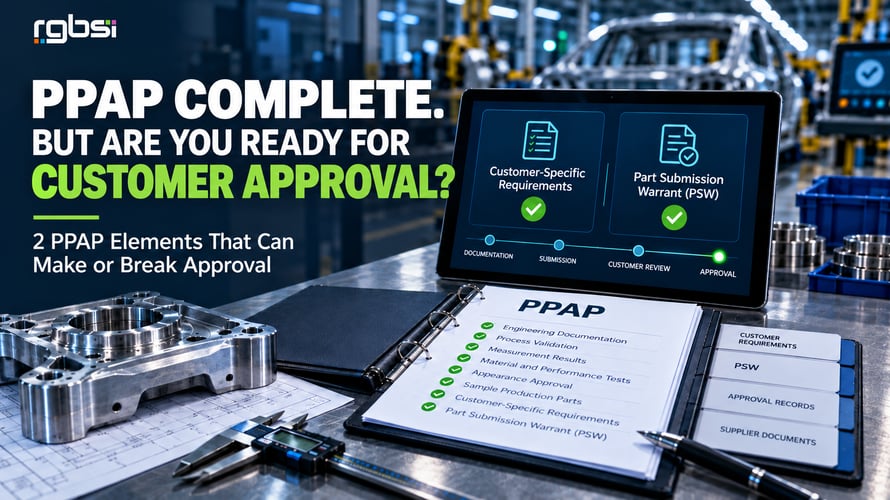
The drawings are approved. The manufacturing process is validated. Inspection results are documented, and production samples meet expectations. Everything looks ready.
But there's one final question:
Will your PPAP submission meet the customer's approval requirements?
A technically complete PPAP package doesn't automatically guarantee customer approval. Missing customer-specific documentation, incomplete declarations, or inconsistencies between records can still delay production.
That's why the final stage of the Production Part Approval Process (PPAP) is about more than collecting documents. It's about ensuring that every requirement has been addressed and the complete submission is ready for customer review.
In the final part of RGBSI's PPAP Readiness Technical Series, we explore two essential elements:
- Customer-Specific Requirements
- Part Submission Warrant (PSW)
Together, they help manufacturers move from documented production readiness to formal customer approval.
Why Final PPAP Readiness Matters
Throughout the PPAP process, manufacturers establish evidence that the product is correctly designed, the manufacturing process is controlled, and production output meets applicable requirements.
But even when these activities are complete, submission gaps can remain.
Common challenges include:
- Missing customer-required documentation
- Incomplete approval records
- Engineering revision mismatches
- Unresolved deviations
- Incorrect submission information
- Limited visibility into outstanding requirements
These issues may appear administrative, but they can create real consequences, including approval delays, additional reviews, and disruptions to production schedules.
PPAP readiness means ensuring that technical evidence and customer expectations are aligned before submission.
1. Customer-Specific Requirements – Does Your PPAP Meet Customer Expectations?
PPAP provides a standardized framework, but customer requirements are not always identical.
Different customers may specify additional documentation, submission formats, approval procedures, or evidence beyond the standard PPAP requirements.
Customer-Specific Requirements ensure that these additional expectations are identified, addressed, and incorporated into the submission process.
Depending on the customer and program, requirements may involve:
- Additional testing or validation evidence
- Specific documentation formats
- Special characteristic requirements
- Customer-defined approval procedures
- Supplier or sub-tier documentation
- Additional traceability records
The challenge is ensuring these requirements are understood early enough to avoid last-minute surprises.
A PPAP package can satisfy standard requirements and still be incomplete for a particular customer.
The key question isn't simply whether PPAP is complete. It's whether it's complete for that customer.
2. Part Submission Warrant (PSW) – The Final Declaration
After completing the required PPAP activities, manufacturers prepare the Part Submission Warrant (PSW).
The PSW serves as a formal declaration summarizing the submission and confirming the supplier's position regarding compliance with applicable engineering and customer requirements.
It typically includes information such as:
- Part identification and revision details
- Customer and supplier information
- Reason for submission
- Submission level
- Applicable declaration and supporting results
- Authorized supplier representative information
The PSW connects the supporting PPAP evidence with the formal customer approval process.
However, submitting a PSW does not automatically mean the part is approved. Customer review and the resulting approval status remain essential.
An inaccurate or incomplete PSW can raise questions about the reliability of the entire submission.
Two Elements. One Final Approval Decision.
Customer-Specific Requirements and the PSW serve different purposes, but they are closely connected.
Customer-Specific Requirements define additional expectations that must be satisfied.
PSW formally communicates the submission details and supplier declaration for customer review.
Together, they help ensure that the PPAP package is complete, consistent, and aligned with customer expectations.
This final stage also reinforces the importance of traceability across all earlier PPAP elements.
A drawing revision, test report, approval record, or deviation that doesn't align with the submission can create uncertainty even when the underlying manufacturing process is capable.
Why Connected PPAP Management Matters in 2026
Manufacturers today operate across distributed supplier networks, multiple production facilities, and increasingly complex product programs.
Managing PPAP through disconnected spreadsheets, emails, and document folders makes it difficult to maintain a clear view of submission readiness.
A connected digital approach can help organizations improve:
- Customer requirement tracking
- Document and revision control
- Submission completeness
- Approval workflow visibility
- Supplier collaboration
- Audit readiness
As part of RGBSI's digital quality portfolio, Empower QLM helps manufacturers manage PPAP documentation, quality records, supplier information, and approval workflows within a connected environment.
Combined with RGBSI's engineering, manufacturing, and supplier quality expertise, this supports a more structured approach to PPAP execution and customer submission readiness.
From 18 PPAP Elements to Production Confidence
Across this seven-part series, we've explored how PPAP connects engineering requirements, manufacturing processes, inspection, validation, physical product evidence, and customer approval.
Each of the 18 PPAP elements contributes to a larger objective: demonstrating that a manufacturer understands the requirements and has established the processes and evidence needed to meet them.
The final lesson is straightforward:
PPAP isn't complete simply because the documents are collected. It's complete when the applicable requirements are satisfied and the submission receives the necessary customer disposition.
That distinction separates documentation readiness from genuine production confidence.
Turn PPAP Readiness into Customer Confidence
Successful PPAP execution requires more than checklists. It demands alignment between engineering, manufacturing, quality, suppliers, and customers.
RGBSI helps manufacturers strengthen this alignment through engineering, supplier quality, manufacturing support, and digital transformation expertise. With Empower QLM, organizations can bring PPAP documentation, customer requirements, revisions, and approval workflows into a more connected environment, improving traceability and reducing submission gaps.
Ready to simplify PPAP management and strengthen customer approval readiness? Connect with RGBSI to build a more controlled, connected path from engineering to production.